
MARKET & COSTS
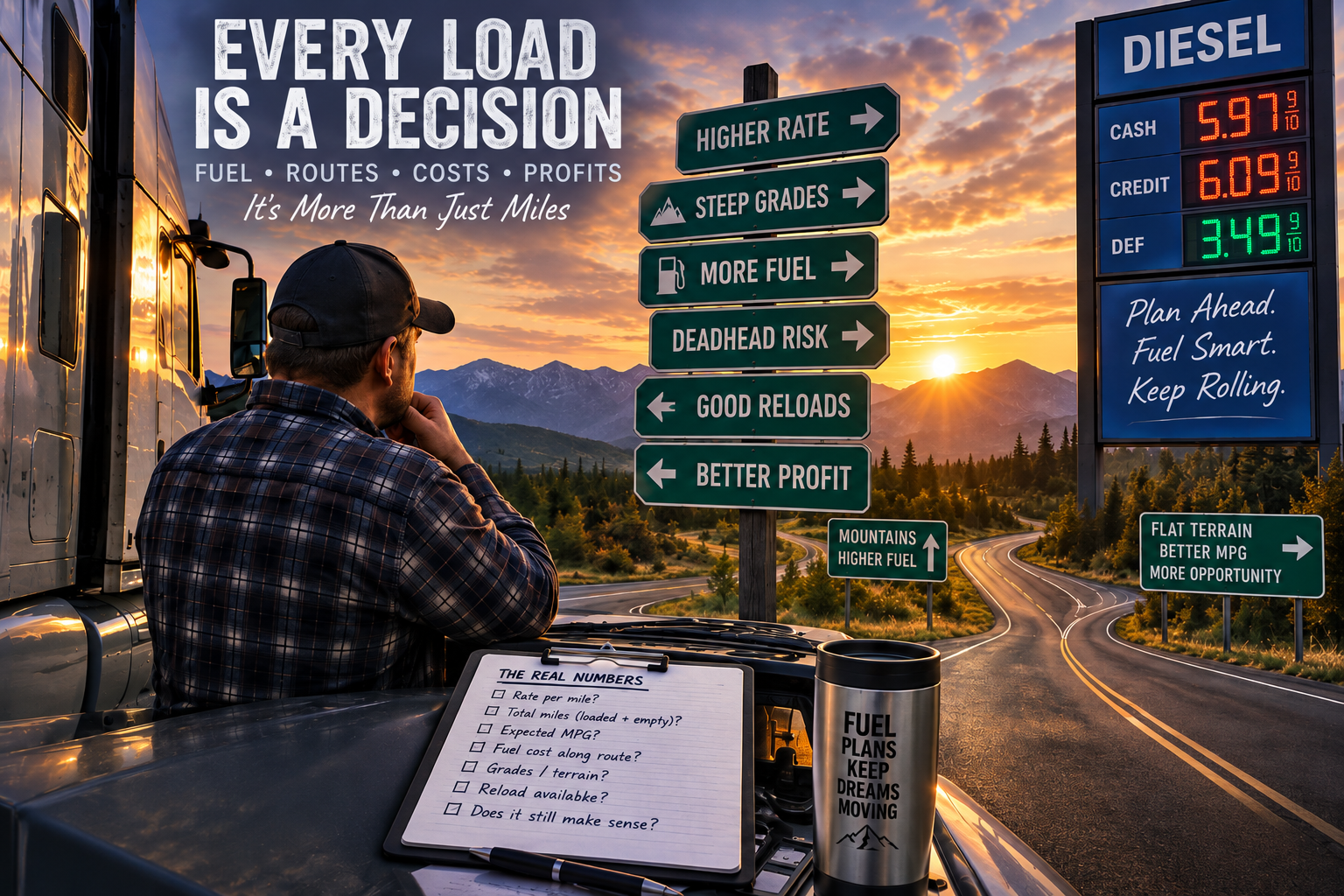
A load can look good on the rate confirmation and still turn out to be a bad load by the time the truck gets home. That has always been true in trucking, but at almost $6 a gallon for diesel, there is a lot less room to be wrong.
The U.S. Energy Information Administration put the national average for on-highway diesel at $5.967 per gallon for the week of September 7, 2026. That was up 36.8 cents in one week and $2.20 higher than a year earlier. The regional spread is just as important. The Gulf Coast average was $5.754, the Rocky Mountain region was $5.805, and the West Coast was $6.987. California averaged $7.764.
When diesel is moving that much from week to week and from one part of the country to another, fuel is no longer something we can simply figure at the end of the month. It has to be part of the decision before the truck takes the load.
That is the way we look at it. The rate matters, but so does the truck pulling it, how heavy the freight is, where the road goes, what the truck normally gets for fuel mileage on that kind of work, how much deadhead is attached to it, where the next load is likely to come from, and what diesel is going to cost along the way. The load that grosses more is not always the load that leaves more money.
At $5.97 a gallon, half an MPG starts looking like real money
Take a truck that averages 6.5 MPG. At the current national diesel average of $5.967, fuel alone works out to about 91.8 cents per mile. If that same truck averages 7 MPG, the fuel cost falls to about 85.2 cents per mile. That difference does not sound dramatic until the truck runs 10,000 miles. Then that half-mile-per-gallon improvement is worth roughly $656 at today’s fuel price.
Now compare 7 MPG with 5.5 MPG. Fuel goes from about 85 cents per mile to approximately $1.08 per mile. On only 500 miles, that difference is about $116. That is why we do not think of fuel mileage as just a bragging number drivers compare with each other. For an owner-operator, it is part of the rate.
And there is no single MPG number that tells the whole story.
A loaded flatbed fighting wind across the plains is not doing the same work as a light dry van. An 80,000-pound combination climbing long western grades is not doing the same work as that truck running lighter freight on relatively flat interstate. An oversize load may change speed, routing, drag and stopping patterns again.
NACFE’s real-world Run on Less work specifically identifies gross vehicle weight, speed, duty cycle, traffic, road type, elevation, temperature and wind as factors affecting truck fuel economy.
So when a truck that normally gets 7 MPG gets 5.8 on a particular run, the question should not automatically be, “What’s wrong with the truck?”
The first question is, what was different about that trip?
The rate has to pay for the road it is sending you down
This is where load selection gets more complicated than rate-per-mile. Suppose two loads both pay well. One runs mostly flat interstate and delivers into an area where freight is easy to find. The other goes through hard grades, heavy traffic and expensive fuel territory, delivers into a weak market and may require 150 miles of deadhead before another decent load appears. The second load needs to pay more. Not because a mountain is automatically a bad lane or a heavy load is automatically bad freight. There is good money in difficult freight when it is priced correctly.
The problem is taking difficult freight at an ordinary rate. A truck pulling hard up grades is going to demand more power and burn more fuel. NACFE even notes that certain powertrain strategies can save fuel on grades by allowing the truck to slow somewhat and remain in a more efficient gear rather than repeatedly demanding more horsepower. We look at that as part of the load.
How heavy is it? Where are the grades? What normally happens to this truck’s MPG on that lane? What’s the weather? What’s the reload? How far do we have to move empty afterward?
Those numbers belong in the decision before the truck leaves.
Deadhead burns the same expensive diesel
This is one of the easiest places for a rate to fool an owner-operator. A broker might offer $3.00 a loaded mile on 500 miles and it sounds like a $3.00-per-mile load. But if there are 100 miles to pick it up and another 150 miles after delivery to get somewhere with freight, the truck actually traveled 750 miles to generate that revenue. That does not automatically make the load bad. It simply means $3.00 loaded mile was never the real number. The real business is done on all the miles.
This comes up constantly in owner-operator discussions. TruckersReport threads about operating cost repeatedly come back to knowing the truck’s true cost per mile rather than judging a load from the gross amount on the rate confirmation.
At today’s fuel prices, ignoring empty miles gets expensive very quickly.
What drivers are actually doing right now
A current September 2026 discussion among truckers dealing with this diesel spike kept circling back to some very ordinary things: drivers are planning fuel stops more carefully, cutting unnecessary idling, slowing down, trying to move through high-traffic areas at better times, and pushing for better compensation when fuel makes a load no longer worth hauling.
Older owner-operator discussions say much the same thing. One driver described settling into a consistent lower cruising speed and avoiding unnecessary passing and repeated acceleration; he reported improving his own long-term average from roughly 6.3 to 6.8 MPG. That is one driver’s experience rather than a guarantee, but the underlying idea is repeated throughout trucking forums: consistency usually costs less fuel than constantly asking the truck for power.
There is a reason the advice survives year after year. A driver cannot control the posted diesel price. He can control quite a bit of what happens after the fuel goes into the tank.
We would rather slow the truck a little than buy fuel just to make wind
There is a balance here. We are not talking about driving so slowly that the truck cannot make appointments or becomes a rolling traffic problem. But there is a difference between running a truck efficiently and constantly running against the governor simply because the truck will do it.
Speed increases aerodynamic demand. Grades increase horsepower demand. Hard acceleration demands fuel. Repeated braking throws away energy that was already paid for. DOE’s fleet-efficiency guidance specifically identifies speeding, excessive acceleration and braking, idling, poor routing and unnecessary shifting as areas fleets address when trying to reduce fuel use. It also recommends route planning to reduce unnecessary miles and time spent in traffic.
We have always looked at it less as “drive slow to save fuel” and more as stop making the truck work harder than the job requires. Sometimes the right answer is backing out of it a little on a grade instead of demanding full power to hold every mile per hour. Sometimes it is letting traffic clear instead of spending an hour accelerating, braking and crawling through it. Sometimes it is simply not racing another truck to the next fuel stop.
Idling is one of the easiest gallons to see
There are times a truck has to idle. Weather, equipment, safety and the realities of living in the truck matter. But an engine that is running while the truck is doing nothing is still burning purchased fuel. DOE’s heavy-truck idle research estimates that a heavy-duty truck can consume about 0.8 gallon per hour while idling. At today’s national average, that is nearly $4.80 an hour just sitting still. Ten hours would be close to $48 in fuel.
That does not mean a driver should freeze or roast in the sleeper to save five dollars. It means idle time is worth knowing. An APU, bunk heater, shore power or other idle-reduction equipment may make financial sense depending on how the truck operates. A local truck that goes home every night has a completely different calculation from an OTR truck where somebody lives in the sleeper five nights a week.
The important part is knowing what your operation is actually consuming rather than guessing.
A fuel stop is now a business decision too
The current EIA numbers show almost a dollar and a quarter per gallon difference between some major regions, and even individual stations along the same corridor can vary substantially.
For one truck, that makes a good fuel-card program and some advance planning especially valuable. A large fleet may negotiate directly with fuel networks, buy in bulk, install yard tanks or enter purchasing contracts. A one-truck operation usually does not have that volume. But small carriers can effectively pool purchasing power through certain fuel-card programs. Fleet-industry sources have long noted that this can give smaller carriers access to discounts they could not negotiate independently.
There is also a point where chasing cheap fuel becomes expensive. We are not driving 30 miles out of route to save three cents a gallon. At 7 MPG, that 60-mile round trip burns more than eight gallons before considering the time involved. The “cheap” fuel would have to be dramatically cheaper before that starts making sense. We would rather know where the good fuel stops are on the route we are already running.
Don’t let the pump price fool you on IFTA
For carriers running under IFTA, there is another layer that gets misunderstood. The lowest pump price is not necessarily the lowest underlying fuel cost because part of that price is state fuel tax. IFTA ultimately allocates fuel taxes according to where the vehicle operates.
That is why experienced owner-operators often compare the net price after the applicable fuel tax, rather than simply buying whichever sign beside the interstate shows the lowest retail number. Current forum discussions still make this distinction.
IFTA itself publishes the official quarterly jurisdiction tax rates.
We do not treat this as a reason to play games with fuel purchases. We treat it as another reason to understand what the actual cost is. A cheap-looking gallon that simply leaves a larger IFTA liability at the end of the quarter did not magically become free fuel.
Tires and maintenance quietly show up at the pump
Fuel economy is also one of the first places a mechanical problem can hide. A truck that suddenly loses MPG deserves attention. It may be the weather, weight, route or driver. It may also be an inflation problem, alignment, dragging brake, intake leak, boost problem, aftertreatment issue or something else making the engine work harder.
TruckersReport discussions going back years include fleet owners saying an unexplained mileage drop often sends them toward an early PM or mechanical inspection rather than simply accepting the higher fuel bill.
Tire pressure is one of the simpler examples. DOE work on commercial-truck tire inflation has estimated that maintaining correct tire pressure can improve fuel economy by roughly 2%–3%, in addition to improving tire life and safety. A few percentage points matter when diesel costs almost six dollars.
This is one of the reasons we like tracking a truck’s normal MPG rather than just looking at the total fuel bill. A change in the number can be an early warning.
Fuel surcharge matters—but only if somebody actually pays it
A proper fuel surcharge can protect a carrier from fuel prices moving faster than freight rates. Some contract operations tie their surcharge directly to a published diesel index such as EIA’s weekly price. In a 2026 FleetOwner survey, fleet respondents described increasing fuel surcharges, using EIA-based formulas, emphasizing yard/network fuel and improving route planning in response to high diesel prices.
That can work very well in contract freight. Spot freight is different. A broker may call the rate an all-in number, with no meaningful separate fuel surcharge at all. Recent owner-operator discussion reflects both situations: some contracted carriers report an automatic fuel surcharge, while others on brokered freight say the only number that ultimately matters is what the broker will pay for the load.
For a small carrier, we think that means you cannot simply say, “There’s no fuel surcharge,” and then take the same rate anyway. Fuel still exists whether it has its own line on the rate confirmation or not. It has to be in the total rate somewhere.
What works for a big fleet is not always what works for one truck
Large carriers have tools that a one-truck operation may never need. They can analyze hundreds of trucks and identify which drivers, routes and tractors are burning more fuel. They can negotiate large fuel purchases, use yard fuel, establish approved fueling networks, govern speeds, use telematics to measure idle time, optimize dispatch across a fleet, and spread technology costs across thousands of miles.
Current fleet-management commentary is increasingly focused on exactly that kind of data-driven cost control, especially as diesel, equipment, maintenance and insurance all squeeze margins.
A one-truck operation cannot beat a 2,000-truck carrier at bulk purchasing. But the one-truck operation has something the big fleet often does not have: agility. An owner-operator can know one truck exceptionally well. He can know what that truck gets pulling 45,000 pounds versus 20,000. He can know what it does in the mountains, what it does against the wind, what speed it likes, which lanes usually leave him empty, where he buys good fuel and which freight consistently makes money. He can look at a bad load and say no without trying to keep 800 trucks moving.
That information can be just as valuable as a giant fleet’s analytics system if it is actually recorded and used.
The truck you buy sets the rules before you ever book a load
This is also why equipment choice matters. A truck spec’d for heavy haul is not necessarily going to be the cheapest truck to run empty down the interstate. A lightweight aerodynamic highway tractor may not be the truck we want for every heavy equipment job.
Rear-end ratio, engine, transmission, tire selection, aerodynamics, wheelbase, idle equipment and the kind of trailer behind it all affect what that truck does well.
NACFE’s fleet research shows just how much room there can be between ordinary and highly efficient Class 8 operations. Its 2024 Fleet Fuel Study reported an average of 7.77 MPG among participating efficiency-focused fleets in 2023, compared with a broader FHWA combination-truck figure of 6.91 MPG for 2022. Those fleets collectively reported hundreds of millions of dollars in fuel savings compared with average trucks.
That does not mean every owner-operator should immediately buy the newest aerodynamic truck. The truck still has to fit the freight. A paid-for older truck that fits the work and runs reliably may make far more money than a brand-new fuel-efficient truck carrying a huge payment. The point is simply that equipment economics and fuel economics cannot really be separated.
A good rate has to survive the whole trip
This is where we come back to the load. We do not want to ask only: “What’s it paying per loaded mile?” We want to know whether the revenue survives the actual trip.
What does the truck normally burn on this kind of freight? How heavy is it? What does the terrain look like? What does the wind look like? What will fuel cost on the corridor? How much deadhead is involved? Is there a reload? Is this a lane where we routinely get stuck waiting? Is there a surcharge? Is the rate high enough if the truck gets 5.8 MPG instead of the 7 MPG we hoped for?
That last question matters. It is easy to make a load profitable on paper by assuming everything goes right. We would rather price the load with some room for trucking to happen. ATRI’s latest operating-cost study shows why. The average cost to operate a truck reached a record $2.336 per mile in 2025, even before the sharp diesel increases we are dealing with now. Maintenance, tires, tolls, insurance, equipment and driver costs do not disappear just because fuel went up.
Fuel is only one piece of the truck. It is just one of the pieces we have the most opportunity to influence every day.
THE EXODUS TAKEAWAY
We cannot control the price on the truck-stop sign. What we can control is whether we know what the truck costs to move. We can know the MPG instead of guessing. We can notice when it changes. We can choose freight with the entire trip in mind instead of only the loaded rate. We can stop wasting fuel where there is no business reason to burn it. We can plan fuel purchases instead of buying wherever the light comes on. We can maintain the truck so it is not fighting itself. And when fuel prices move sharply, we can make sure the rate moves enough with them to keep the truck worth operating.
For a big fleet, some of that happens through software, purchasing departments, telematics and contracts. For an owner-operator, a lot of it happens with a calculator, a fuel receipt, a rate confirmation and knowing the truck.
The scale is different. The business principle is the same:
The miles only matter if there is money left after you buy the fuel to run them.
Important Note
Exodus Truck & Trailer shares this information for general educational purposes based on our trucking experience, publicly available industry data, government fuel information, and practices discussed across the trucking industry. It is not financial, tax, mechanical or legal advice. Fuel economy varies substantially by truck configuration, load, terrain, weather, speed, driver, maintenance condition and operating environment. Fuel-card terms, fuel-surcharge agreements, IFTA requirements and tax treatment also vary. Before making a business, tax, maintenance or compliance decision, verify the numbers for your own operation and consult the appropriate qualified professional or official source when needed.
Sources & References
- U.S. Energy Information Administration — Gasoline and Diesel Fuel Update. Used for the September 2026 national and regional on-highway diesel prices and the comparison with prior weeks and years.
- U.S. Energy Information Administration — Diesel Prices and Outlook. Used for background on what makes up the retail price of diesel, including federal and state fuel taxes and other price components.
- U.S. Department of Energy, Alternative Fuels Data Center — Efficient Driving to Conserve Fuel. Used for information on speed, aggressive acceleration and braking, routing, tire inflation, maintenance, telematics, and other factors that affect fuel consumption.
- U.S. Department of Energy — Long-Haul Truck Idling Burns Up Profits. Used for the estimate that a heavy-duty truck can burn about 0.8 gallon of diesel per hour while idling and for the broader cost of long-duration idling.
- North American Council for Freight Efficiency — Run on Less and Fleet Fuel Study. Used for real-world information showing how weight, speed, terrain, elevation, traffic, wind, equipment choices, and driver practices affect Class 8 fuel economy, along with current fleet-efficiency benchmarks.
- American Transportation Research Institute — 2026 Analysis of the Operational Costs of Trucking. Used for the broader cost context showing that the industry-average cost to operate a truck reached $2.336 per mile in 2025.
- International Fuel Tax Association — Official IFTA Tax Rate Matrix. Used as the official reference for quarterly jurisdiction fuel-tax rates and the discussion of comparing fuel costs in an IFTA operation.
- FleetOwner — Fuel Purchasing Strategies Survey. Used for the fleet perspective on bulk purchasing, fuel contracts, fuel surcharges, route planning, and other strategies larger carriers are considering as diesel prices rise.
- TruckersReport owner-operator discussions. Used only for real-world operating perspective on knowing cost per mile, experimenting with speed and driving habits, avoiding unnecessary acceleration and traffic, and tracking actual MPG. These are individual driver experiences, not controlled research.
Leave a Reply