
MAINTENANCE & DOWNTIME
There is always something on a working truck that could use attention. The challenge is knowing which problem can be scheduled for the next maintenance window and which one can cost you a load, put you on the shoulder, or turn into a citation or out-of-service order if you keep rolling.
The checks in this article are the kinds of things we pay attention to because they are the things that tend to become expensive when they are ignored. Some are straight compliance items. Others may not be DOT violations by themselves but are common ways a truck ends up broken down away from home.
The goal is not to replace a mechanic or memorize the entire FMCSR. It is to catch the obvious problem while you still have control over where, when and how it gets repaired. And the roadside numbers tell you where to spend your attention first.
During CVSA’s 2026 International Roadcheck, inspectors conducted 44,047 Level I, II and V vehicle inspections and placed 10,350 vehicles or combinations out of service. Brake systems were the leading vehicle OOS violation, followed by tires, defective brakes, cargo securement and lighting.
That is why brakes, tires, wheel ends, air systems, lighting, securement and documentation deserve more attention than cosmetic or convenience items.
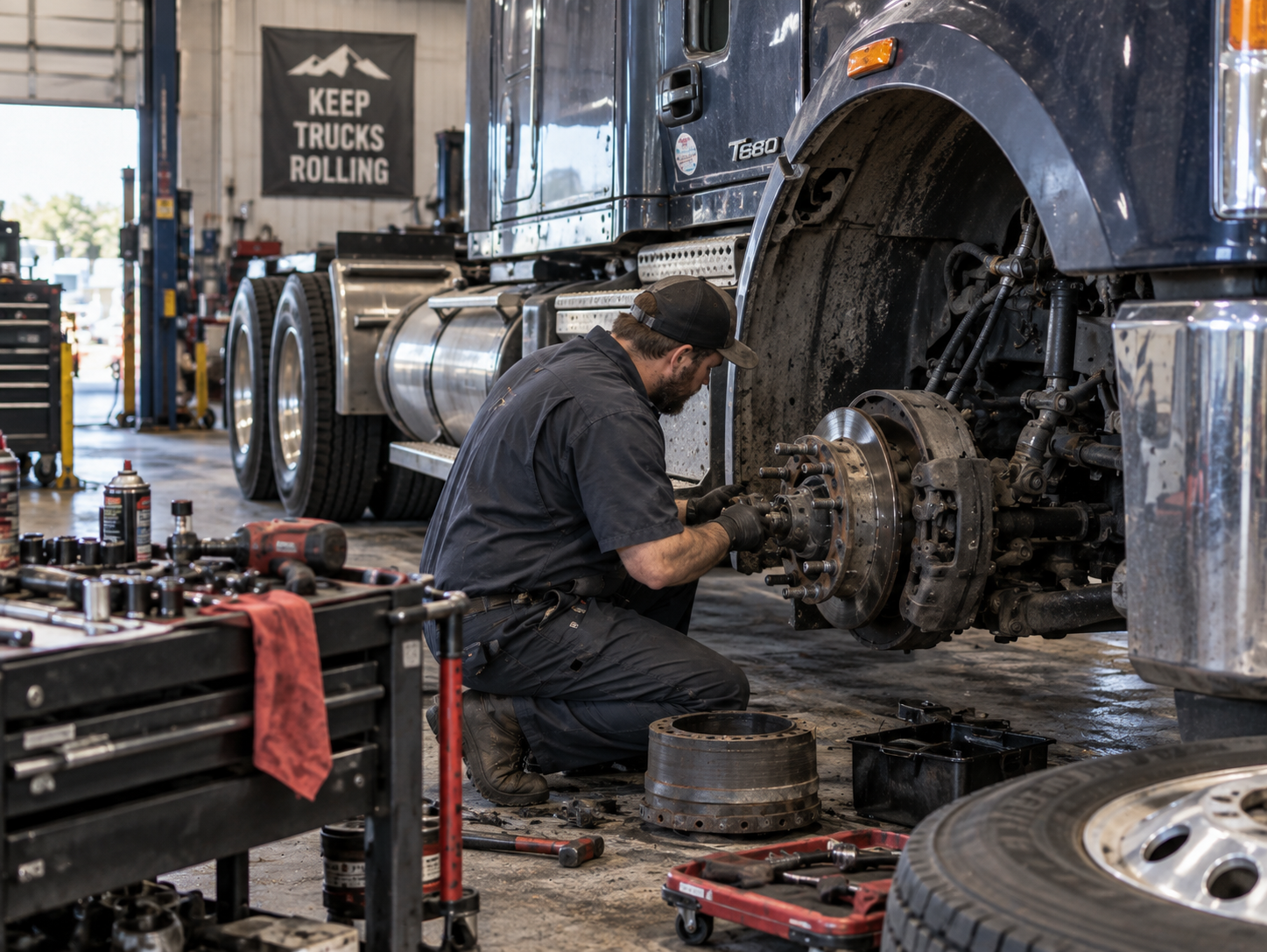
Brakes: fix the problem before the inspector finds it
Federal regulations require a driver to be satisfied before driving that service brakes, trailer brake connections, parking brakes and other listed safety components are in good working order. 49 CFR §392.7 also specifically calls out steering, lights, tires, coupling devices, wheels and rims, and emergency equipment.
The brake regulations go further. Brake components must be maintained for safe, reliable stopping, with minimum lining/pad thickness and limits on brake actuator travel set in 49 CFR §393.47. All required brakes generally must remain capable of operating under §393.48.
That makes things like these high-priority problems:
air leaks around brake chambers or lines, a dragging brake, abnormal brake pull, noticeably hot wheel ends, oil or grease getting onto braking surfaces, damaged hoses, loose or broken components, brake-adjustment problems, or a change in stopping performance.
Those are not good “watch it for another week” items.
A brake problem found in your own yard gives you choices. A brake problem found in an inspection lane gives the inspector the choices.
Tires: know the legal floor, but do not wait for the legal floor
49 CFR §393.75 prohibits operation on tires with exposed ply or belt material, tread or sidewall separation, a flat or audible leak, or a cut that exposes ply or belt. Steer tires must have at least 4/32 inch tread depth in a major groove, while most other tires must have at least 2/32 inch. The rule also requires sufficient inflation for the load being carried.
That is the legal minimum, not necessarily the smartest replacement schedule.
If a tire suddenly begins wearing on one edge, feathering, losing pressure, running hotter than its mate, showing a bulge or developing irregular wear, find out why. The tire may be the symptom rather than the original problem.
Alignment, suspension wear, wheel-end trouble, inflation and loose components can all turn one tire purchase into two.
Lights: one of the cheapest problems to catch before the scale
Required lamps must be operable under 49 CFR §393.9.
And in FMCSA’s 2026 national roadside inspection data, inoperable required lamps were among the most frequently recorded violations. The same dataset also shows periodic-inspection documentation and brake-adjustment violations near the top of the list.
That is a good reason to actually walk the truck with the lights on instead of assuming they worked yesterday.
Check the tractor and trailer: brake lights, turn signals, tail lamps, markers, clearance lights, identification lights and other required lighting.
A bad bulb, corroded socket, broken wire or poor ground can often be fixed cheaply at home. The repair does not get cheaper because DOT found it first.
Annual inspection paperwork can cost you even when the truck is mechanically sound
Every commercial vehicle, including each unit of a combination, is required to receive a periodic inspection at least once every 12 months. FMCSA also requires documentation of the current periodic inspection to be available on the vehicle.
FMCSA’s 2026 national inspection data lists operating without documentation of the periodic inspection as the most frequently reported violation in the dataset snapshot.
That is one of the easiest problems on the list to prevent.
Check the tractor and trailer inspection dates before they expire, make sure the documentation is actually accessible, and do not assume the sticker on the side of the trailer is all you need if you cannot produce the required information when asked. FMCSA specifically says the driver must know where the documentation is and be able to produce it.
Cargo securement: recheck it after the load settles
Federal cargo securement rules require cargo to be loaded and secured so that it does not leak, spill, blow or fall from the vehicle and does not shift enough to adversely affect vehicle stability or maneuverability.
During the 2026 International Roadcheck, cargo securement accounted for 1,724 out-of-service violations.
For flatbed and equipment-hauling work, this is why the second look matters.
After the load has moved a few miles, check chains, binders, straps, anchor points, dunnage and anything that may have settled or shifted. A tiedown can loosen without completely failing. A strap can begin rubbing through. A binder can change tension. The machine itself can settle onto the trailer differently than it looked in the yard.
Five minutes with the load may save hours later.
Emergency equipment and the little things that still get written up
49 CFR §393.95 requires emergency equipment on power units, including the required fire extinguisher and warning devices.
Those are easy to overlook because they do not affect how the truck drives.
Make sure the extinguisher is present, properly secured and serviceable, and make sure the warning devices are actually on the truck.
FMCSA inspection data routinely records violations for missing, discharged or unsecured extinguishers and missing/improper warning devices.
That is exactly the kind of avoidable citation that should never be discovered in the scale house.
What can usually be planned instead of treated like an emergency?
A working truck will always have lower-priority items.
A minor seep that is not reaching brakes or exhaust, is not creating measurable fluid loss and is not worsening may be something you document and schedule.
A weak battery that still starts the truck reliably may give you enough time to test the batteries and charging system and replace them on your schedule.
A shock showing age but still securely mounted is different from a broken or loose suspension component.
Cosmetic damage, worn trim, paint, upholstery and nonessential accessories usually belong lower on the list.
The difference is that “can wait” should still have a plan.
Write it down. Watch it. Set a repair date or a condition that moves it up the list.
A seep that becomes a drip is no longer the same problem.
A vibration that gets worse is no longer the same problem.
A tire that starts wearing rapidly is no longer the same problem.
The problems that strand trucks even when DOT never gets involved
Some expensive failures are not roadside-inspection violations at all.
Cooling-system issues are a good example. A hose beginning to deteriorate, a small coolant leak, a weak clamp, failing belt or tensioner, water-pump issue or radiator problem can turn into an overheated truck before any inspector ever sees it.
The charging system is the same way.
Slow cranking, repeated low-voltage problems, corroded or heating battery cables, failing batteries or alternator trouble are much cheaper to diagnose in your yard than after the truck will not restart at a fuel stop.
And do not ignore a new vibration.
A vibration that changes with road speed, engine speed, acceleration or braking is telling you something. Tire, wheel-end, driveline and suspension problems rarely improve because you keep driving them.
The Exodus way of looking at it
We try to catch the cheap problem before it becomes the expensive version of the same problem.
A hub beginning to leak at home is a repair.
A hub that fails on the road can become a hub, spindle, brake, tow and missed-load problem.
A questionable steer tire in the yard is a tire.
A tire failure on the highway can become roadside service, body damage, lost time or worse.
A loose light connection at home is a few minutes with a meter.
The same issue discovered during an inspection can become a violation and wasted time.
That is the difference between maintenance on your schedule and repair on somebody else’s schedule.
Important note
Exodus Truck & Trailer shares this information for general educational purposes based on our own trucking and equipment experience along with publicly available regulations, inspection data and industry sources. It is not a substitute for a qualified mechanic, certified inspector, attorney, safety professional or the current Federal Motor Carrier Safety Regulations and applicable state requirements. Vehicle configurations, operating conditions and legal requirements vary. When a condition may affect safe operation or compliance, stop and verify it with the appropriate qualified professional and consult the current regulation or official agency guidance before operating. Regulations and out-of-service criteria can change, so always verify the current requirements for your operation.
Leave a Reply